The ‘Liddesdale’, Nancy Astor’s Electric Canoe Restoration.

IMG_0946

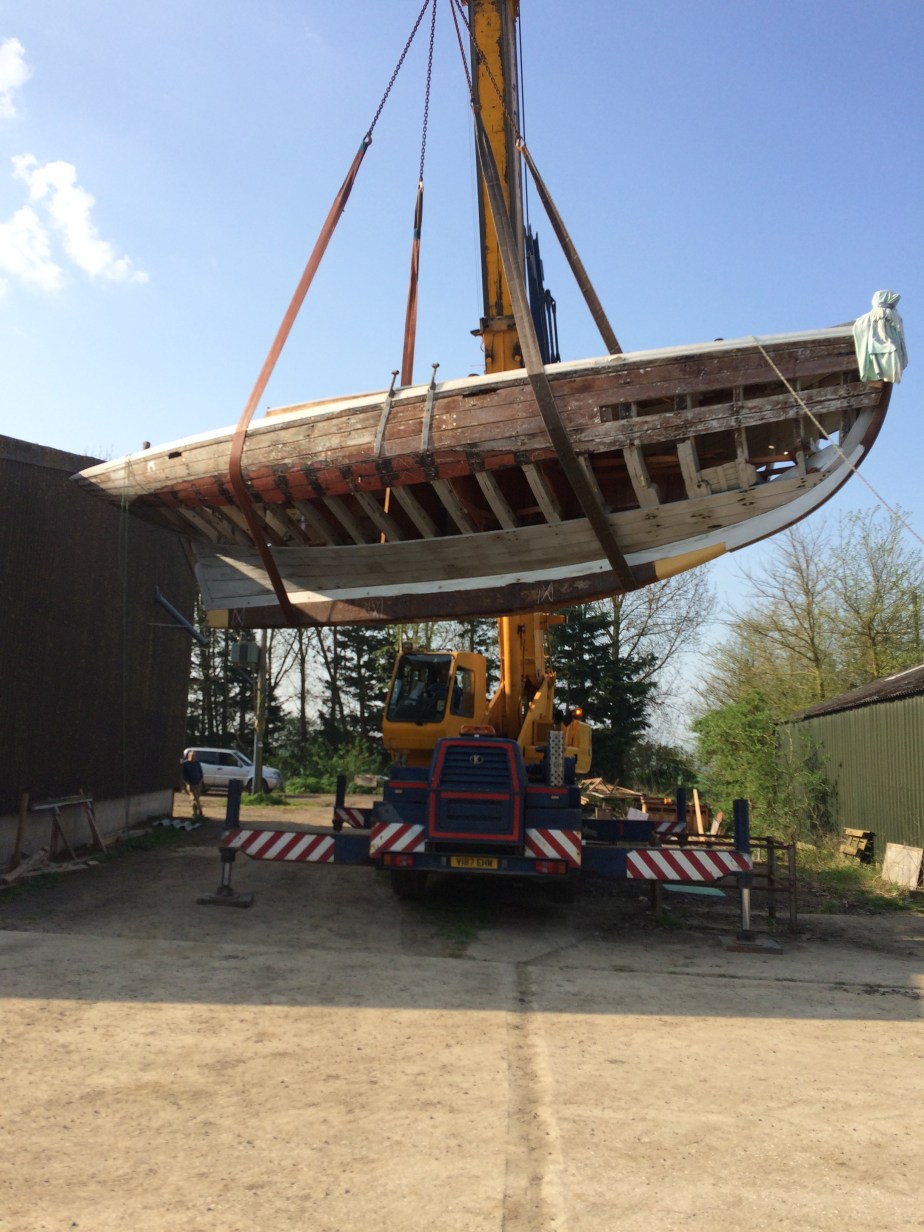
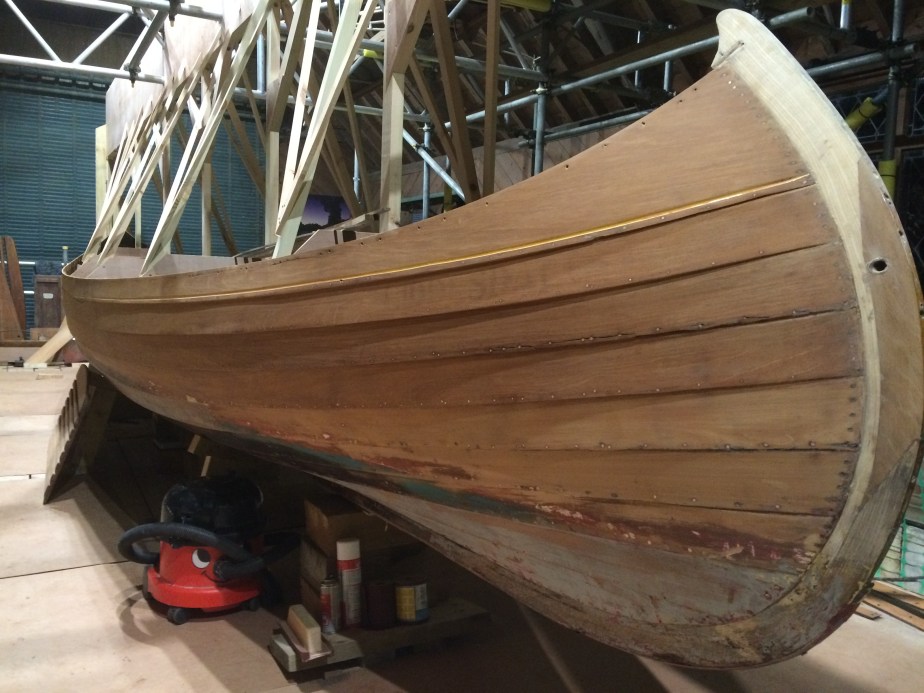
The ‘Liddesdale’ was built for Lady Nancy Astor, locally to the Cliveden Estate in Buckinghamshire where the Astors lived until 1967. It’s an electric canoe, 25’7 3/4″loa and clinker built of brazilian mahogany on rock elm timbers, with ash stems and a pitch pine keel. The National Trust now own the vessel and she is being restored by us in Cliveden’s boathouse, which was built for the Duke of Sutherland. The project is being conducted with full access to visiting public and is generating quite a lot of excitement.

Electric canoes were the very height of fashion on the Thames in the twenties but there are now only half a dozen or so from the era left of which this vessel is one. We intend to return her to the water by summer 2019 for trials, and the National Trust are hoping to offer visitors the chance to take river trips in the canoe from 2020 onwards.

Phase one of the works has included strongbacking and straightening the vessel as she was quite severely twisted at the bow. We have to replace all the steamed timbers as many are rotten or snapped, in order to do this we have rewound the boatbuilding process. With the vessel held in shape we have removed all the fit out, fore and aft decks and coamings, gunwales and inwales. We have stripped the varnish, antifoul and bilge paint, and cabinet scraped, sanded and five starred every single wooden piece. Right now we are starting to remove every other steamed timber in preparation for the rebuild next year.

Apart from steamed timber replacement, we intend to replace some planks below the waterline and repair cracks to extant planks on the topsides. The lower stems need replacement as they are rotten, and the vessel needs new stern gear as there is little left of the original due to corrosion. Incidentally the strongback and moulds will allow us to create a table of offsets and lines drawing as there are currently no plans in existence for the vessel.

The whole project is fantastically exciting and a chance to indulge in some extremely fine restoration techniques. I’m thrilled to have been selected to return the ‘Liddesdale’ to her element and by next summer our own humble boatbuilding history will be intertwined with some very famous history indeed. And the National Trust will have a brand new, old boat with which to illustrate this history, alive and well and on the water. She is going to look a million dollars!

Planta Genesta, and her ‘whisky plank’

We decided that for the very last plank, it would be best to observe tradition. So, on the last day of this stage of the job we invited some friends over, liberally anointed them and the final plank with whisky, before driving it home to complete the hull. Thats me in the check shirt and hat in case you wondered. Three months work all came to an incredibly fulfilling conclusion, and I am very much looking forward to the next stage of works to rebuild this vessel which will commence sometime in November.

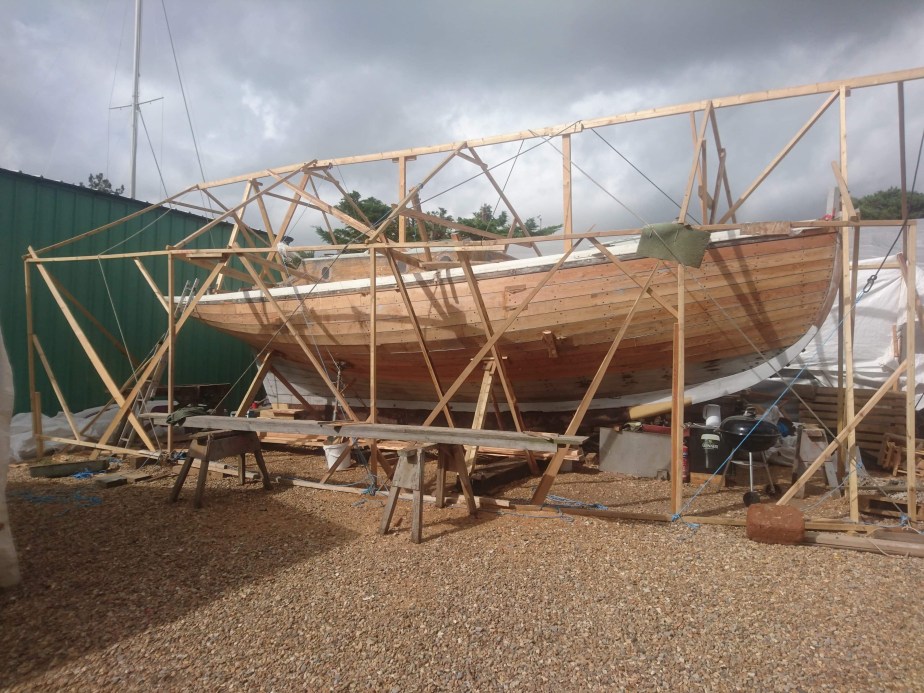
A recent storm took the tarpaulin cover that we spent the summer working under away, which has given us a rare bonus view of the vessel as a whole, so I’ve included it here to give an indication of Planta Genesta’s sense of presence:

IMG_0689

Planta, shutting the hull up.


IMG_0617

Here she is, all done on the port side, and ready for fairing.

Below is pictured some finial repairs to the sheer planks where they meet the new stem. These are two inch thick planks, scarfed to the original sheer. The curved detail was started with a router and finished by hand with block planes and chisels. These are pictured before finishing, but you can see how they’ll look when they’re fastened home.


Planta, frame repairs.

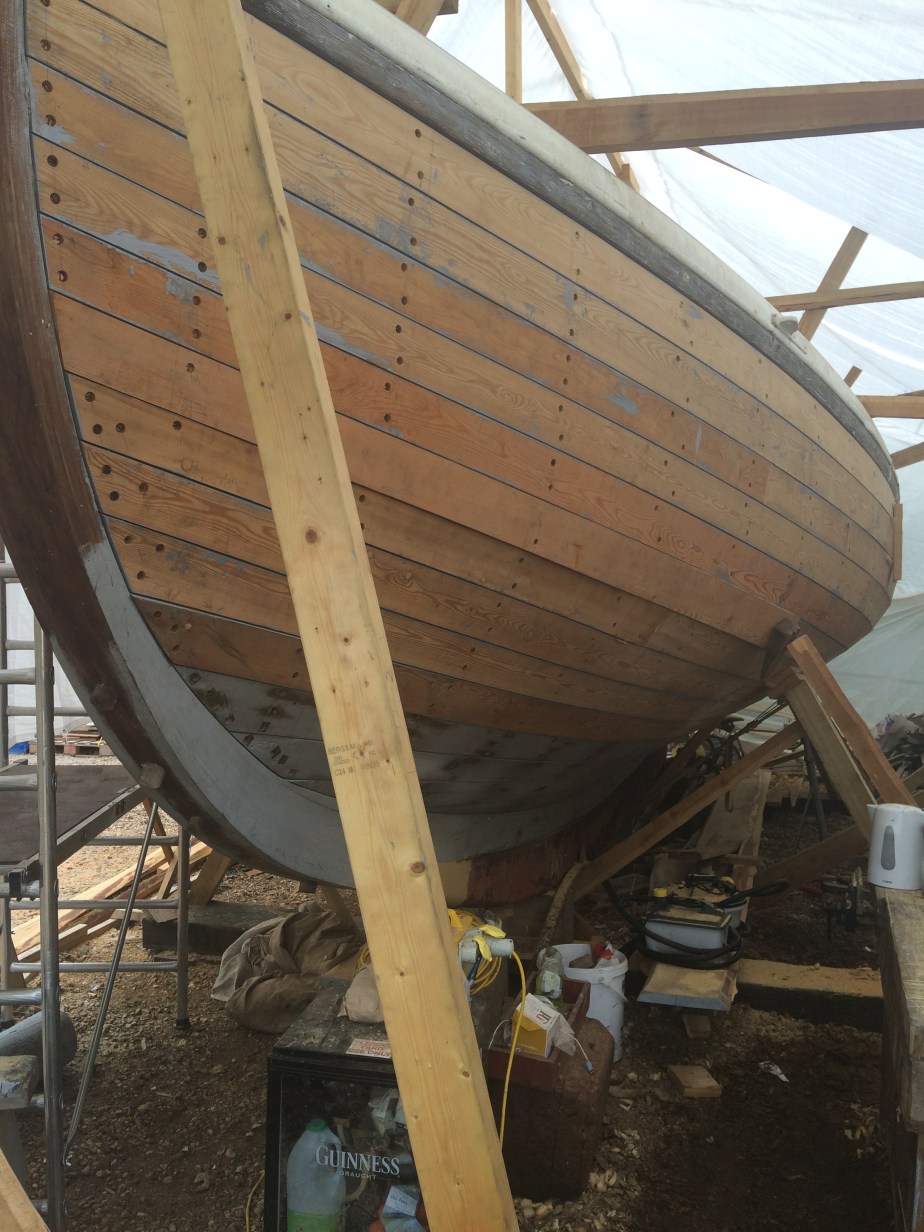
All the new planks were by now throwing the rather tired state of the topside planking into sharp relief. We decided to remove them and replank entirely, as this would be as quick or quicker than painstakingly repairing what we had. Off came the upper planks, which exposed the frames. Most of which were wonderfully sound, simply requiring splinting of the old fastening holes. It was a slightly different story around the area of the cockpit, and a few futtock ends had substantial repairs carried out. Three on on side and one on the other were replaced altogether, using 2 inch thick iroko with oak treenails fastening them together.

Planta, planking up, part one.

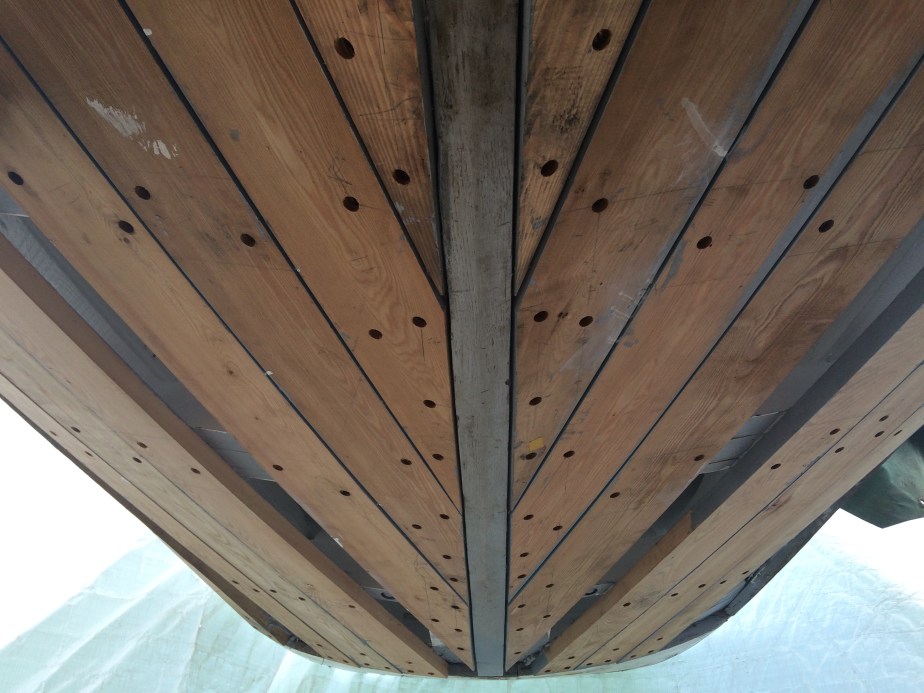
The first four strakes were done in 1 1/4 inch Siberian Larch, fastened with Silicon bronze screws. I tried to keep the planks as long as possible whilst paying attention to the shift of scarf joints as we went up, which means a fair few twenty foot planks. Scarfs were bonded with epoxy, and then through fastened too for good measure. Caulking seams should be about the width of a pound coin thickness at their outermost. Every plank and frame was primed before assembly to provide good ‘husbandry’ for the future.

Planta, the tuck planks.

IMG_0319

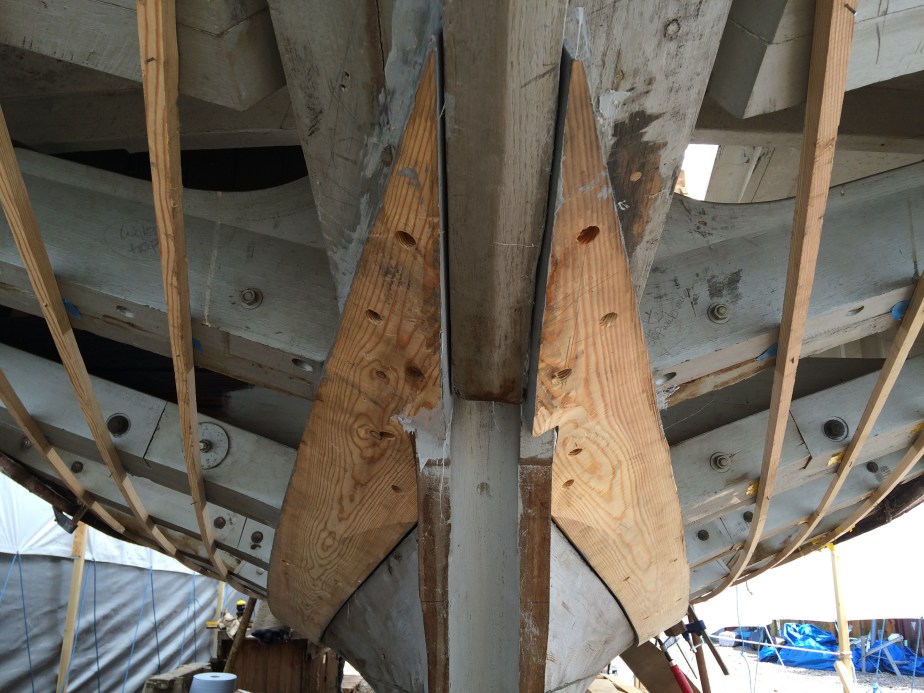
The first planks that were actually to be fitted were the trickiest and deserve special mention. This, because they had to accommodate the ‘tuck’ meant that they started out at over an inch and a half thick. They were heftily rounded over on the inner face to meet the sternpost, horn timber and associated frames. We fitted them with just the inner face shaped, leaving the exterior to be done as part of fairing the hull as a whole. This explains why they look a bit too thick in this picture, but the inner shape fays beatifully onto the structure of the vessel.

Planta, lining out for planking.

Initially, we decided to replank the big gaps that were already there along each deadrise, and since this would involve five strakes each side I began by making up plenty of batten and dividing the space with them to define where the new planking seams would lie. This enabled me to ensure that all the new seams would have nice, fair curves. I also produced a simple router jig that would facilitate quick and reliable production of planking scarfs. There would be an awful lot of these joints to cut and this simple method ensured a quick and precise fit.

Then a cubic metre of Siberian Larch was delivered, and planking could begin.

Planta Genesta.

IMG_0030

First job upon graduation has been a real surprise and privilege. Planta Genesta is a 32′ Morecambe Bay Prawner, built as a yacht on the Isle of Man in 1911. She was rescued from the chainsaw, simply because the previous owner had already done so much work in renewing much of the backbone and associated structure. Here she is in her ‘as found’ state in the process of being transported to Emsworth, where we have begun the rebuild in earnest.

I was hired to run the job of eventually seeing this vessel return to the water and in the next few posts I will present photographs of the replanking work to the hull as it progressed.

Victory class Boom.

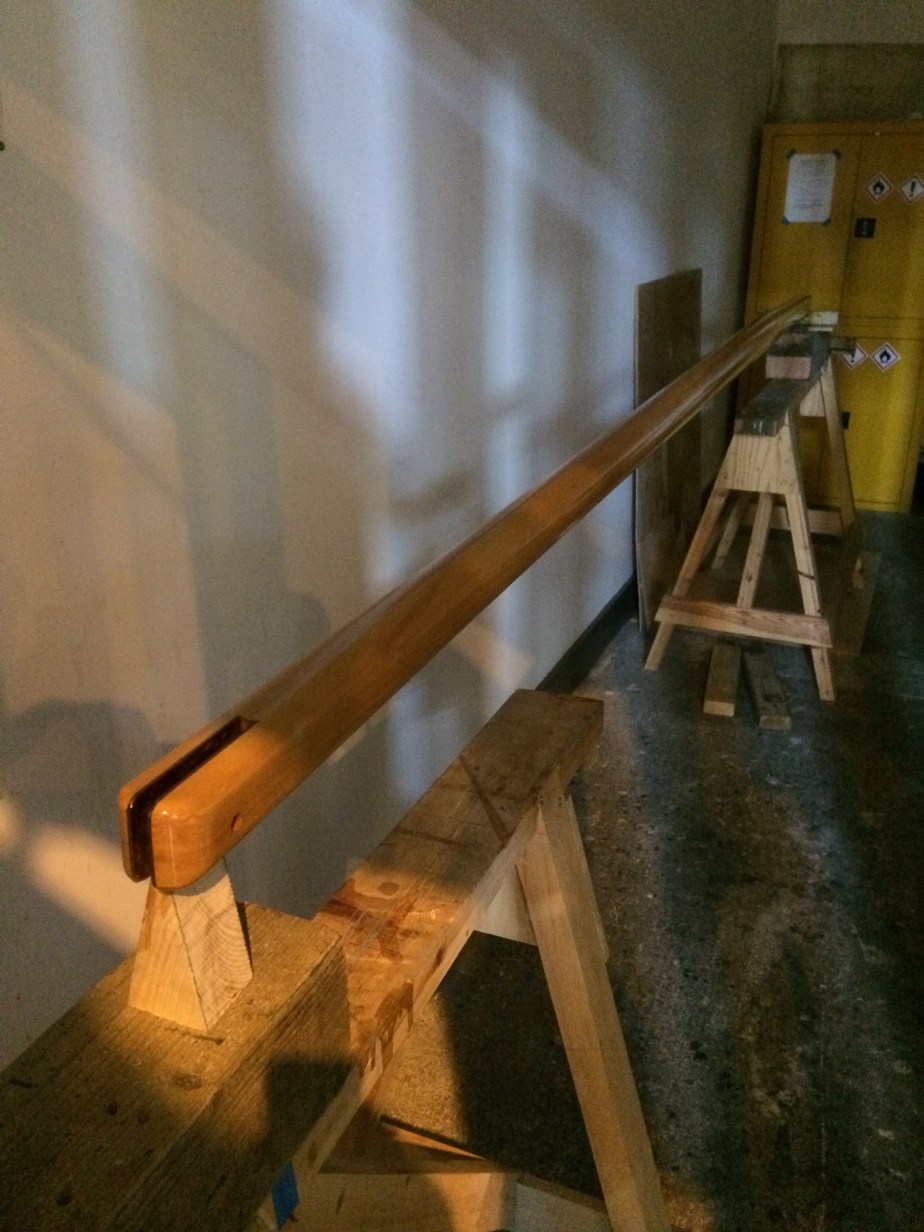
Made from sitka for another customer at Portsmouth Victory Sailing Club, this boom is an exact copy of a broken Jon Perry boom. Split and glued back to back and end to end, this was a lovely egg shaped section to do, tapering to almost square ends to accept downhaul and gooseneck fittings. 12 coats of varnish to finish the job.

IMG_0135