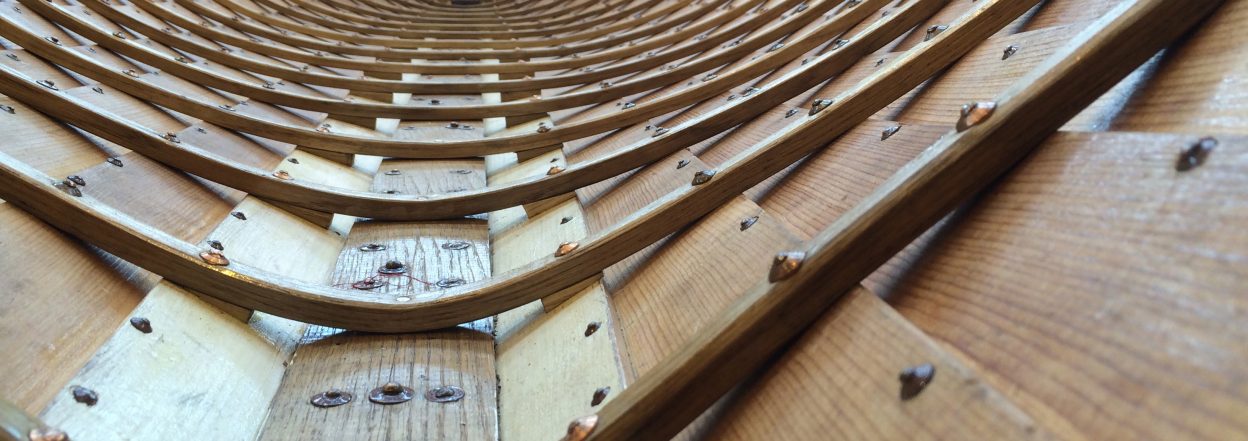
I have decided that carvel planking is more or less the most fun you can have with your clothes on. Back on Lilian, I learned all about bevel sticks, shut planks and another way of spiling by use of dividers which is fast and accurate. I also made myself a natty brass planking bevel gauge. It’s really satisfying getting a plank to sit just so on the planking seam so there are no gaps, before planing in a lovely caulking seam two thirds of the way into the thickness. And thunking a shutter plank home has a satisfying completeness to it. I look forward to doing much more in the near future.
Month: February 2018
Chubby’s Garboard.
Here’s the plank I did for my city and guilds exam. It’s a bit special because it’s a garboard strake to a new keel and stem. It’s also a shutter, as there is an existing adjacent plank. It’s also a bit special because it’s done in elm.
You can see the hooked bits of old bandsaw blade that I developed, they are tied in position effectively clamping the garboard in position for final fit. This worked brilliantly and was a bit ‘look, no hands!’ which enabled me to go for a cup of tea halfway through.
Advanced lofting.
I was offered the opportunity to engage in an unusual lofting process. Our Victory class one design was being built with information from a battered set of plywood mould patterns from 1934, and some lovely old drawings of the same shapes. We have a copy of a construction drawing which is slightly distorted and therefore cannot be scaled from. But no lines drawing and no table of offsets. The vessel is to be built within 1/4 inch tolerance on certain dimensions in order to be ‘in class’. In an earlier post you will see that we have already built the backbone, but without any of the rabbet lines cut. However the college wanted the vessel lofted in order to establish correct angles for the rabbet line etc.
and to define the shape of eight floor timbers that they may all be cut on the bench.
It was an amazing thing to do, I led the process, working with student colleagues and on my own, it took me about three weeks. I learned that the plywood mould patterns were indeed sound. I was able to cut mould patterns of my own, lifting information directly from the lofting. I also designed the floor timbers and made bevel sticks for all of them.
Mentoring.
After Christmas I found myself in the position of mentor to two groups of students. The activities involved were ones that I’d expressed great interest in pursuing further and the tradeoff was that I would learn about what it is to lead a group of students.
Firstly, I spent a week teaching the basics of the magic of steaming, putting new timbers into Lilian, with a new group of six students each day from Southampton Solent University.
Secondly, I spent a fortnight engaged in an advanced lofting process for our victory class yacht. This was my vehicle for teaching the principles of lofting to my own junior colleagues who had just graduated joinery.
Both experiences were surprisingly intense work, and very positive. I learned a lot about communication and patience, and the occasions of seeing a light bulb come on in another’s mind as understanding clicked were well worth it.